One thing that I am torn about is whether or not having restaurants is a good or a bad thing. On one hand they are a great way to bring people together allowing them to be social. They can also help express different cultures and provide immigrant communities with a “taste of home”, or something that is familiar to them in such an unfamiliar place. On the other hand, however, restaurants are extremely wasteful. According to the EPA, America throws out an average of 38 million tons of food per year. The maddening part about this is that most of this waste can be prevented. From first studying food waste in school while pursuing an environmental science minor, to actually seeing it first hand from working in the industry and going to culinary school, this is a big problem and not enough is being done to fix it.
One of the biggest and dumbest causes of food wasting is cosmetics. Tons and tons of food is thrown away by grocery stores and suppliers just because it doesn’t look perfect. Lopsided tomatoes, oblong bananas and discolored apples are all thrown away despite being perfectly fine to eat. This is before the food even gets to the restaurant or into someone’s home. In the restaurant, food is thrown out if a mistake is made or if you order too much and can’t get through it all. Again, perfectly good food thrown away. Additionally, all of this food going into landfills is adding to global climate change. Food in a landfill does not decompose like it normally would. Because of all the trash piled up and inorganic material, food in landfills decomposes anaerobically (without oxygen) and produces methane gas. This gas has been shown to be much worse in terms of the effect that it has on climate change compared to carbon dioxide.
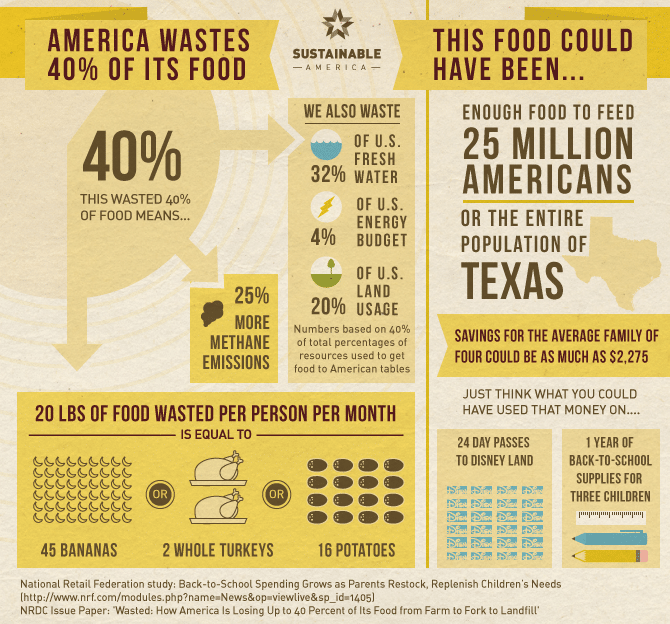
Because of this waste, more food is needed in order to actually feed the global population. This is why anyone who claims that the world is “overpopulated” and that we can’t grow enough food for a larger population is just wrong. Not only can we support a much larger world population with this food system, we do, the excess is just thrown away. Therefore, I think that it is up to restaurants to reduce how much food they throw away and to buy from distributors who don’t waste perfectly good food for frivolous reasons. One way places can do this is to compost the food that they have left over. This is actually what my culinary school did. We had a giant composter in the back of the school that we would dump all the food and paper waste. This was decomposed and used as fertilizer in the school garden, where we grew vegetables that we then used in dishes. Thinking of food waste in this cyclical fashion (waste, compost, fertilizer, food) rather than a linear one (waste, dumpster, landfill) is essential to making restaurants more sustainable. Obviously not every restaurant is going to be able to do this on the scale that my culinary school did, but if smaller places can start thinking in this way, it will considerably improve the situation.
I currently work at a smaller restaurant that definitely does not have the means to compost our food waste, but we are on a block with about a dozen other restaurants, a handful of which we share an alleyway with. We already share a dumpster and recycling bin with these other restaurants, why not a composting machine? It would be a whole lot better for the environment and it could also be lucrative for the restaurants that use it. They could form a cooperative and jointly own the compost machine, they could then sell that compost as fertilizer and make a profit off of it. While this shouldn’t be something for a profit, that’s unfortunately how many people think. As long as we stay in a capitalist system, there will need to be a monetary advantage to fix environmental issues, whether that be food waste or a reduction in carbon emissions.
I want restaurants to be something good. I want them to live up to their potential as a social space where you can enjoy the company of friends or discover new foods and through those new foods, new cultures. A place where you don’t have to worry about whether or not the place you’re eating is practicing a sustainable model or if they’re throwing away tons of food. I want this because at this rate restaurants will be a thing of the past. With global temperatures rising alongside droughts and floods becoming more frequent, food prices are already skyrocketing. Just last summer my school stopped buying celery because droughts in California had killed off fields of them and the price to get them was astronomical. These increasing prices will make it harder and harder for restaurants to stay open, mainly effecting small, family run operations. Urging restaurants to become more sustainable is just a small step in fixing the bigger issue, but I think it could be a vital step to take. If a restaurant demands more sustainable practices from their distributors, that would make the distributors more sustainable in order to keep the business of these restaurants. It would hopefully cause a domino effect, making the entire food industry become sustainable. But that could just be wishful thinking.
 The Cultural Chef
A great and honest perspective to the issue of food waste in the hospitality inductry.
LikeLiked by 1 person
*industry.
LikeLike