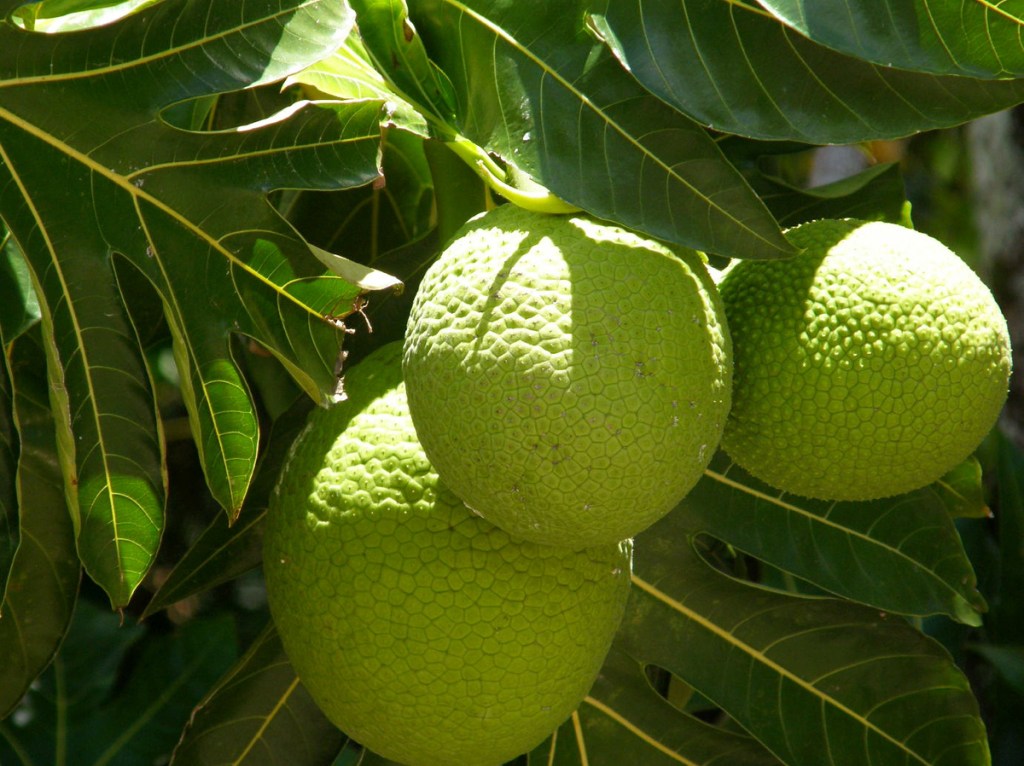
One afternoon, as I was relaxing on my day off, I received a very emphatic text from one of my work friends. We had been developing a menu based off foods that usually aren’t found in American restaurants. He told me that one of our other coworkers, who is Jamaican, told him about this fruit that tasted more like bread or a potato than sweet like most other fruits. It was called a breadfruit and was something that had flown totally under my radar, but was a staple in other parts of the world. A fruit that is vital to the survival of thousands of people in the Caribbean and Polynesia.
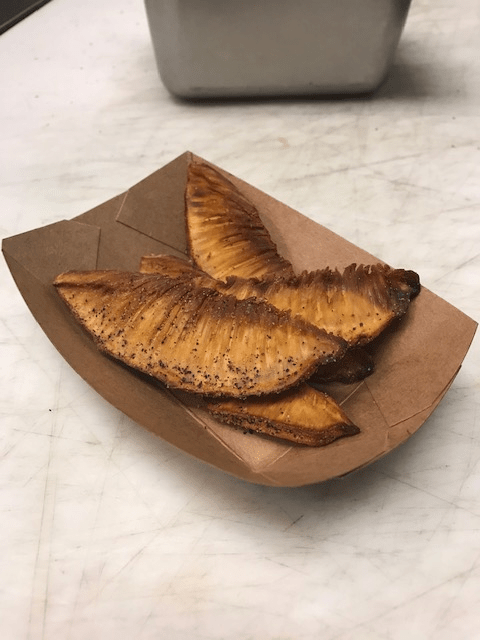
Naturally, I was intrigued and wanted to taste it as soon as I could. So after a week of looking, we finally found a supermarket that sold breadfruit and we bought one. We first baked it until it was tender and tried that out. After tasting it that way we decided to deep fry it and salt it. The flavor of this fruit if very unique, it tastes very hearty, almost like a potato. There is a hint of a raisin flavor as well with a slight bitterness at the end. (Probably because our breadfruit was a little under-ripe.) It is unlike any fruit I have ever had, and the nutrients packed in it are outstanding. It has a high amount of carbohydrates and protein, as well as a high dose of vital vitamins and minerals such as Vitamin C and Potassium. The fact that it is very nutrient dense is the reason why it is a staple in the many equatorial countries it is grown.
The breadfruit plant is native to the Philippines and New Guinea, but was spread throughout Polynesia when the first Polynesians set out to inhabit the islands of the Pacific. The plant was taken as a source of food for these early explorers on their search for new lands and then planted once they reached their destinations. Because of this, breadfruit is now found on every island from New Guinea to Hawaii. This shows just how important this fruit was to these people and how much they relied on it for food. The canoes and ships that were used in these expeditions were not very big, so packing only the essentials was key. Breadfruit was one of these items they deemed essential. A story in Hawaiian folklore shows just how important this fruit was to them culturally:
The god of war Ku, was living as a mortal with his family when a famine arose. To end the famine for his family, he had to leave and never come back. Every day the family wept in the spot they last saw him. After days of doing this, a plant sprouted from the spot and grew into a breadfruit tree, thus ending the famine and saving Ku’s wife and children from starvation.
As is shown from this story, the breadfruit plant was seen as a gift from the gods, saving humans from starvation on otherwise desolate islands. Even today, breadfruit is a popular food eaten in this area of the world, especially by the native Hawaiians in the dish poi, in which they sometimes substitute tarot root for breadfruit.
Breadfruit found its way to the Caribbean in 1796, when slave traders saw the potential for this fruit to feed large amounts of people for cheap. They transported these trees to Jamaica, one of the trade hubs for the slave trade where slaves would be dropped off in exchange for raw goods like sugarcane and chocolate which were sent back to Europe. The slave trade has long since ended, but the utility of the breadfruit in the Caribbean still endures today. Dishes in the Caribbean include flan de pana, and tostones. It is also boiled in soups as well as eaten raw in salads.
The breadfruit is a very important food for people living on islands around the equator. It was thought to be a gift from the gods that allowed Polynesians to inhabit the many islands of the Pacific, and was brought along on every sea voyage they went on. Despite its early use as a food source for slaves in the Caribbean, people living there now rely on the breadfruit as a staple food to feed their families and have created many dishes using the fruit. In my journey to discover and learn about foods I haven’t had exposure to, the breadfruit is one of the most interesting to me currently. With such a rich history and cultural importance, I believe more people should know about it and try it, so maybe they can learn something and connect to a culture other than their own.
1. Shannon Wianecki (May–June 2013). “Breadfruit”. Maui Nō Ka ʻOi Magazine, Haynes Publishing Group. Retrieved 17 January 2017
2. http://powo.science.kew.org/taxon/urn:lsid:ipni.org:names:582598-1
 The Cultural Chef
Interesting, I have never come across this either. Do you know what some of the traditional dishes are they have it with?
LikeLiked by 1 person
Sometimes Hawaiians will use breadfruit in poi as a substitute or addition to tarro root. In Puerto Rico they’ll make it into tostones which is flattened, fried pieces of breadfruit. In Jamaica it is traditionally served alongside ackee and salt fish, their national dish.
LikeLike