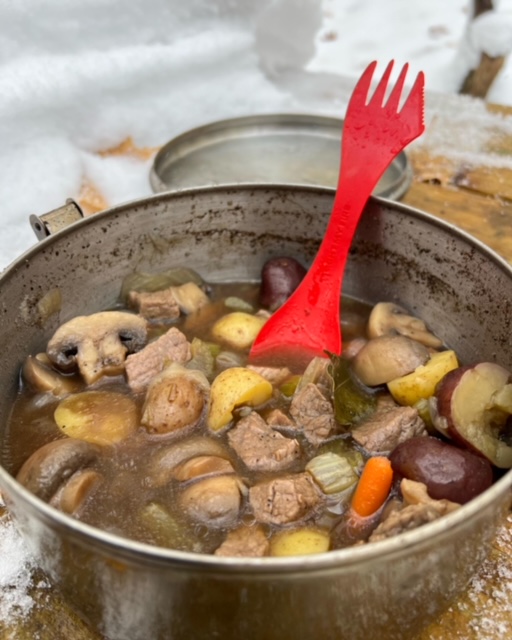
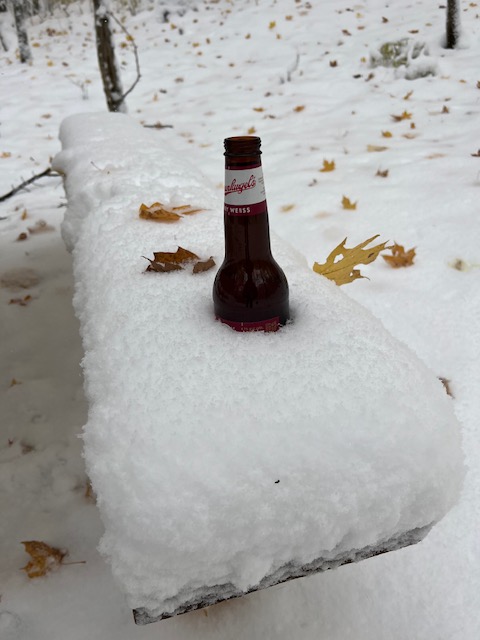
In mid-October, I went on a solo camping trip to the far Northern part of Wisconsin. I saw that the area was expecting some snow during the time period that I had booked but, as it was still early in the fall, I expected light flurries at the most. During my first night there I found out I was in for a lot more than I anticipated. Over the three days I was there, half a foot of snow fell on my campsite making the trip a lot harder than I had originally thought it would be. I wanted to use this trip to test my cooking skills in a more primitive environment than what I am used to. I decided to bring the makings for beef stew. Little did I know, I was taking part in a Northern Wisconsin tradition by making what locals call Booyah. I’m not sure if it was the harsh conditions and being extremely cold, but this was one of the most satisfying meals I’ve had in recent memory and I’m almost afraid to make it again in case I don’t like it as much as I did before.
Booyah is a cooking tradition of the Upper Midwest, primarily in Northern Wisconsin, Minnesota, and the Upper Peninsula of Michigan. It is attributed to the Belgian immigrants that settled in these areas, and the name itself comes from the Walloon language. Walloon is an endangered romance language that originated in Wallonia (area in Belgium) and is also a language spoken in Northern Wisconsin. The name comes from the Wallonian words bouillir (boil) and bouillon (broth). Booyah comes in many different varieties, but generally consists of chicken, beef and/or pork, carrots, peas, onions and potatoes. The seasoning depends on the cook, but from what I have seen consists of bay leaves, black pepper and salt. In my recipe, I swapped out the peas for mushrooms and my seasonings also included cloves. Also, a lot of the time Booyah will have multiple types of meats, mine only used beef. So, mine wasn’t strictly traditional. Today, the stew is made in huge batches, meant to serve hundreds of people for large gatherings. There are even Booyah cooking contests, similar to chili cookoffs, where cooks come together to compete to see who makes the best Booyah.
The more I experience and learn about Wisconsin, my home state, the more I come to appreciate it. Growing up, I’ll admit, I couldn’t wait to leave the state. I thought that Wisconsin culture was stale and boring and wanted something more dynamic and exciting. But now I’m realizing that there is a lot more to Wisconsin than I thought. The traditions and cultures represented in Wisconsin are very deep and unique to the state. This was all exposed to me through food and studying the culinary traditions of the state. I would never have known that there is an endangered language being spoken in pockets of Northern Wisconsin if it weren’t for Booyah stew. Food has made me appreciate where I’m from more than I ever thought I would.
References:
- “Origin of Booyah.” UW – Green Bay – Wisconsin’s French Connections Origin of Booyah, https://web.archive.org/web/20101024041613/http://www.uwgb.edu/wisfrench/kitchen/booyalet.htm.
- JESSIE OPOIEN | The Capital Times | jopoien@madison.com | @jessieopie. “Booyah! This Northeastern Wisconsin Tradition Could Become the Official State Soup.” The Cap Times, 10 Dec. 2015, https://captimes.com/news/local/govt-and-politics/booyah-this-northeastern-wisconsin-tradition-could-become-the-official-state-soup/article_8c8c4a0b-afee-516f-a00b-ae998cd57108.html.
- Mf. “Walloon Ancestry in Wisconsin (USA).” Phlegmish & Walloony, 1 Jan. 1970, https://phlegmish-walloony.blogspot.com/2015/10/walloon-ancestry-in-wisconsin-usa.html.
 The Cultural Chef