In this new series of blog posts, I will be discussing different foods that are available to be foraged in the wild and aren’t commonly cultivated or available in most grocery stores. In this series I will go over the cultural significance of these foods, what part is eaten and share different ways in which these foods are consumed. I will primarily be covering species that are found in the Great Lakes Region, as that is where I am located, and it is what I’m familiar with. Also, as a disclaimer, these blog posts are not meant to be used as a guide to forage on your own. If you are interested in foraging, I would recommend doing a lot of research on your own. One resource I would highly recommend if foraging in the US is Sam Thayer’s book “Sam Thayer’s Field Guide to Edible Wild Plants of Eastern and Central North America”. This book will be the main source of information regarding identification in this series of blog posts. My own foraging journey began as a child when I would be out exploring with my family and would come across different edible berries. I have recently rediscovered my interest in foraging and have been researching as well as going out and collecting edible wild foods. My perspective on these blog posts will combine my studies of anthropology, culinary arts and the natural world (also known as ethnobotany) to hopefully give a well-rounded account of these different foods.
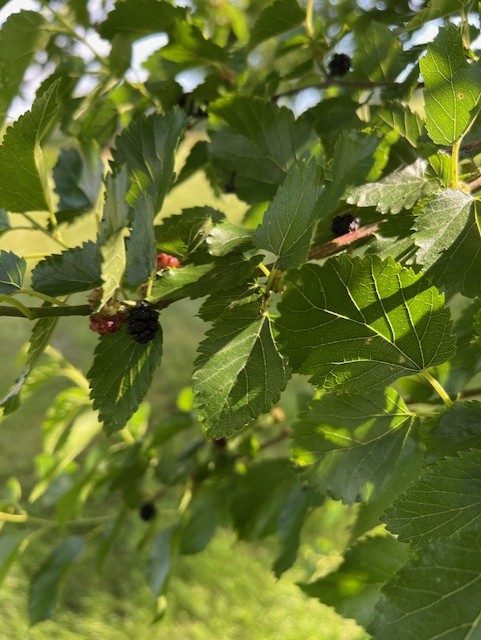
Mulberry trees include many different species of plants in the Moraceae family. These will all produce edible mulberries and the trees, as well as the fruits, are relatively easy to identify. The berries of the mulberry tree look very similar to blackberries and the trees have ovate to heart shaped serrated leaves. The berries ripen in early to mid-summer and will often ripen unevenly, meaning you will be able to harvest the same tree multiple times. These trees have a world-wide distribution, growing in hardwood forests with rich soil. I always find mulberry trees in the woods when I go hiking or in parks. There is a native mulberry tree species, the red mulberry, but it is in decline because of genetic mixing and being outcompeted by the foreign mulberry trees that were brought over from Europe and Asia. Most of the mulberry trees you will find will be the foreign species of mulberry.
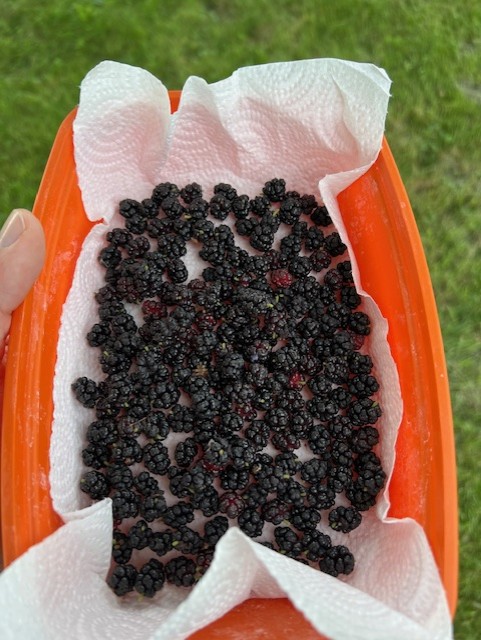
The main part of this plant that is eaten are the berries, these are gathered by either hand picking or by shaking the branches onto a tarp for larger quantities. You can also use the new, tender leaves and shoots in salads and cooked in soups or as a tea. The berries are used in pretty much every way that any other berry is used. You can eat them raw, make mulberry pie, or mulberry jam. Processing mulberries can be labor intensive because they have a lot of seeds and stems. However, the work is definitely worth the reward. Mulberries have a deep, rich and dark flavor. When ripe, they aren’t overly sweet or sour. I think they are much more flavorfully complex than similar berries like raspberries.
The mulberry tree played a key role in the Chinese Silk Trade. Mulberry leaves are the main food source for silkworms, so they were cultivated in order to sustain a large population of silkworms that could then be used for their silk in the silk trade. In fact, the reason why mulberry trees are so widely distributed is because of the silk trade. Ancient Greeks and Romans also cultivated mulberry trees for this purpose. The red mulberry tree was used as a food source for Native Americans before the introduction of white and black mulberry trees which have taken over the red mulberry’s native habitat. A Babylonian myth says that the gods made mulberries have blood-red juice because of the deaths of lovers Pyramus and Thisbe, who committed suicide because their love was forbidden. As shown here, the mulberry tree is linked to human history from all over the world. It is such an important tree with a diverse array of uses to many cultures all over the world and isn’t specific to just a single group of people.
The mulberry tree is one of my favorite trees to find in the wild. It’s so fun and rewarding to be able to identify a species of plant and be able to eat it too! Mulberries are a great introductory plant to get people into foraging because it is super easy to identify and has no toxic lookalikes. Diving into the history of human use of mulberry trees is quite interesting as well. Its use among so many different cultures throughout the world and human’s tendency to take this plant wherever they go is a testament to its importance to us. With how sweet and accessible the taste is, it’s surprising to me that there aren’t more mulberries or mulberry products in grocery stores. But to those who know where to look for it, it provides a tasty treat!
- https://foragerchef.com/mulberries/
- Reich, Lee (2008). “Morus spp. mulberry”. In Janick, Jules; Paull, Robert E. (eds.). The Encyclopedia of Fruit and Nuts. CABI. pp. 504–507
- Lyle, Katie Letcher (2010) [2004]. The Complete Guide to Edible Wild Plants, Mushrooms, Fruits, and Nuts: How to Find, Identify, and Cook Them (2nd ed.). Guilford, CN: FalconGuides. p. 103.
- Thayer, S. (2023). Sam Thayer’s Field Guide to Edible Wild Plants of Eastern and Central North America.
 The Cultural Chef