These blog posts are not meant to be used to identify plants to eat, they are meant for educational purposes to learn about different wild foods used by people who are able to identify them. If you are interested in learning how to forage your own wild foods, you need to learn as much as you can about plant identification as possible. Samuel Thayer’s book “Sam Thayer’s Field Guide to Edible Wild Plants of Eastern & Central North America” is a great resource in learning how to identify edible plants if you are foraging in the United States. But I cannot stress enough, do not eat anything unless you are absolutely sure what it is.
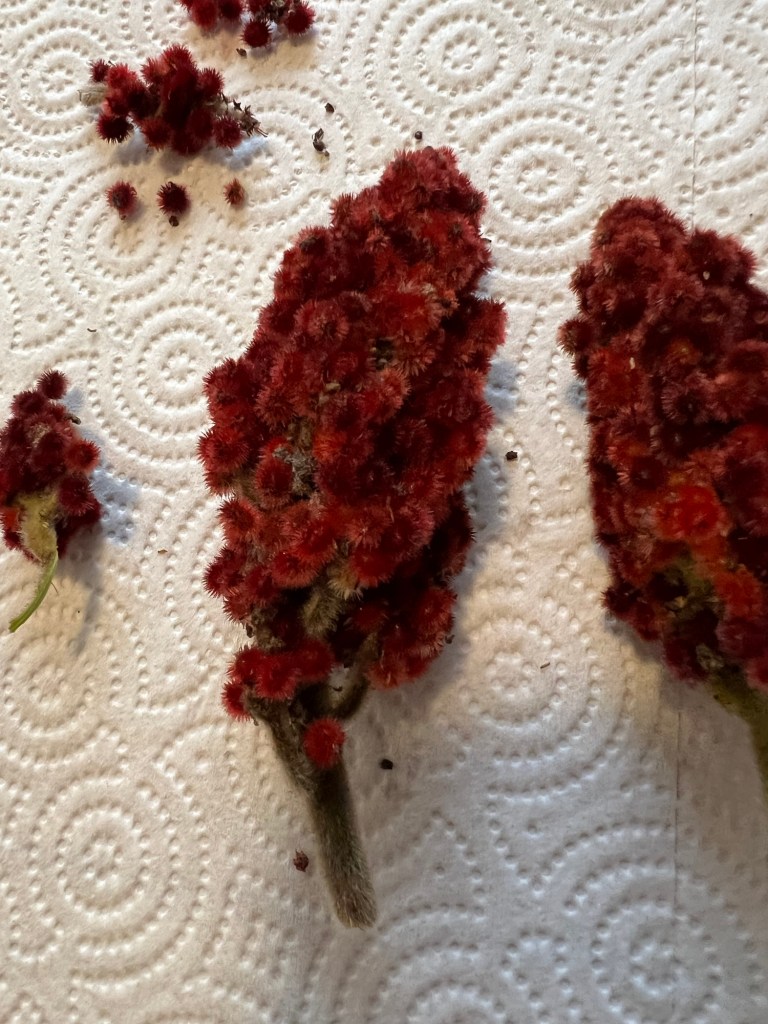
Staghorn Sumac (Rhus typhina) is one of my favorite plants to forage. It is easy to identify because of how unique it is. The berry clusters are these red, hairy spikes that grow straight up from the top of the shrub. The stems of the plant also have small hairs covering them. They have compound leaves that also have small hairs on the bottom of the leaflets. Staghorn sumac is native to North America and is found around the Great Lakes and east to the Atlantic Coast and stretches south to the Appalachian Mountains. There are many different species of sumac, however the only poisonous one is Poison Sumac (Toxicodendron vernix). This species will be easy to identify by their white berries, the other species all have red berries.
The main part of the plant that is used for food are the berries, however the shoots are also edible in the early spring. Sumac berries are crushed and used to make seasoning and is especially famous in za’atar seasoning, however usually the berries of Fragrant Sumac (Rhus aromatica) are used for that. My favorite use for Staghorn Sumac berries is to make sumac lemonade. Sumac lemonade is such a refreshing, tart drink that has so much flavor without having to add a ton of things to it. The berries are very acidic which gives it that refreshing taste. (I’ll attach a recipe for sumac lemonade at the end.) Sumac berries are loaded with antioxidants and also has antimicrobial effects as well. The best time to forage for Staghorn Sumac berries will be in the late summer and into the fall and can even continue until early winter. The berries will stay on the plant a lot longer than the leaves which will be an easy identification indicator if foraging later in the season when the leaves have dropped.
Sumac is a plant that is revered worldwide for its delicious flavor. Za’atar seasoning comes from the Middle East and is widely used in Middle Eastern cuisine as well as in Mediterranean cuisine. While sumac isn’t the main ingredient in this herb blend, it provides a very distinct flavor to this seasoning. Sumac as a seasoning has gained popularity in fine dining restaurants because of its unique flavor and flexibility as a seasoning. Staghorn Sumac specifically was an important food source for Native American people living in the Great Lakes region. In fact, the sumac lemonade recipe comes from Native American food traditions. The sumac plant is used widely for ornamental purposes and is considered invasive in some areas. In places where this plant is invasive, indiscriminate foraging of the berries could help slow their spread. (However, sumac mainly spreads through rhizomes so it would still be a problem.) In their native habitat, foraging for sumac berries is fairly low impact to the plant and overall population which makes this a very sustainable food.
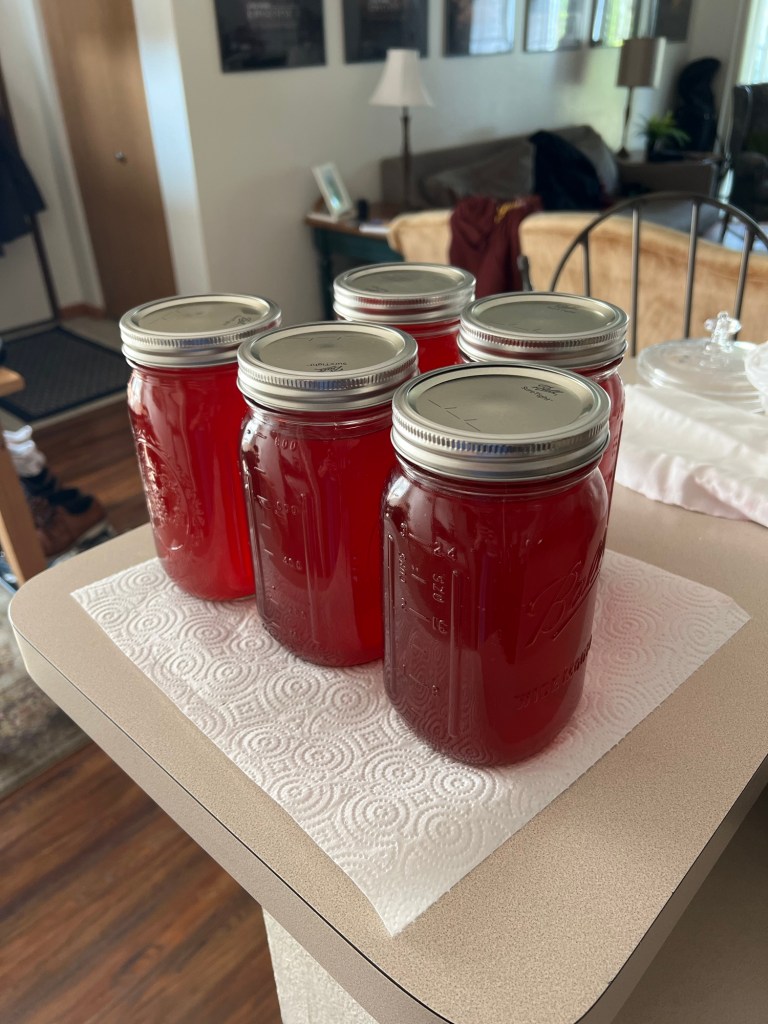
Sumac Lemonade Recipe
- 5 cups sumac berries
- 4 quarts cold water
- Mint sprigs (to taste)
- 1 cup honey
- In a large container, combine water, sumac berries and mint sprigs. Stir and make sure the mint sits below the sumac berries so that it is fully submerged in the water.
- Let mixture steep for at least 24 hours either at room temperature or in the refrigerator, stirring every so often.
- After 24 hours, strain the liquid through a cheese cloth and discard the solids. Add honey and mix well. This should make around 5, 32 oz mason jars worth of lemonade. Refrigerate after portioning out and it should last at least a week in the refrigerator.
Sources
- https://foragerchef.com/staghorn-sumac-lemonade/#recipe
- Peterson, Lee Allen (1977). Edible Wild Plants. New York: Houghton Mifflin. p. 186
- “Rhus typhina Range Map” (PDF). United States Geological Survey. Archived from the original (PDF) on 2012-06-26. Retrieved 2008-03-02.
- Gary Allen (1 October 2010). The Herbalist in the Kitchen. University of Illinois Press. pp. 237
- Thayer, S. (2023). Sam Thayer’s Field Guide to Edible Wild Plants of Eastern and Central North America.
- Deere, S. (2022). Foraging Medicinal Herbs and Wild Plants in the Great Lakes Region.
 The Cultural Chef
I always wanted to make sumac lemonade, but I always wait too long and the sumac clusters are picked by the birds and full of bugs. It looks so refreshing!
LikeLiked by 1 person
Now is a great time to forage for sumac! At least in my area, (Wisconsin) I’m still seeing loads of berries still!
LikeLike