When I was first starting out in culinary school, one of the first things we were taught was how to make clarified butter. While the process was being explained to us, one of the other students spoke up, saying “Oh! This is kind of like ghee!” With my very limited knowledge of food at the time, I had absolutely no clue what they were talking about so I looked up what ghee was. After some research I found that, while the cooking techniques were the same, ghee and clarified butter are very different religiously, culturally and symbolically.
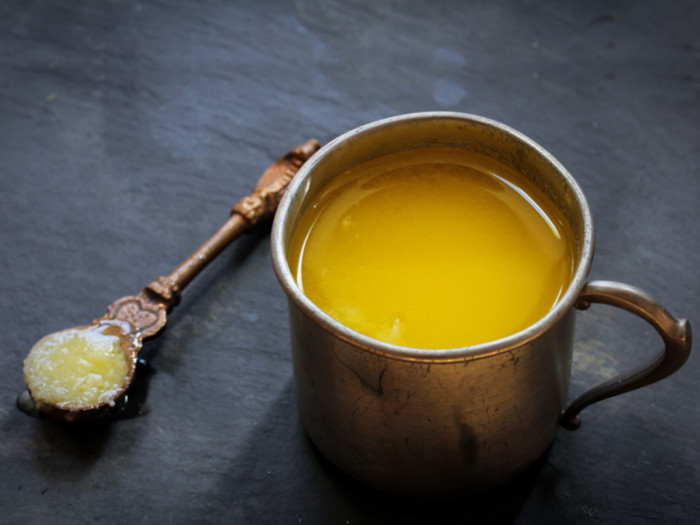
The cooking process for both ghee and clarified butter are basically the same. You first take whole butter and melt it in a pot. You continue to cook it until the water in the butter settles to the bottom of the mixture or evaporates completely and the solids float to the top. You then skim the solids off, pour the fat into a container and discard the remaining water at the bottom. What you are left with is pure fat that looks clear with a yellow tint, almost honey-like. The only difference in production is that in ghee, this is then simmered, which gives it a nutty flavor. (1) In the culinary world, clarified butter is used to sauté as well as in emulsions like hollandaise sauce. This is where the similarities of clarified butter and ghee end. While clarified butter is just prized for its practical uses in western cooking, ghee is prized for many other reasons in Hindu and Indian cooking.
Ghee is always made from cows milk, as cows are sacred in Hinduism. It is a requirement to have ghee for the Vedic rituals yajna and homa. (2) These rituals involve making offerings in front of a fire and are often done during marriages and funerals. Hindus also use ghee in order to worship divine deities such as Krishna and Shiva. Because of this religious aspect of ghee, the purer it is the better, as only the purest ghee are offered to the gods. (2)
Ghee is also popularly used in Indian cuisine and is often the star ingredient in many dishes. Biryani is one that many westerners might be familiar with and includes ghee in its preparation. Other dishes made with ghee include puranpoli, khichdi and kahdi. Ghee is also used to top naan and other types of bread, similar to how western culture uses butter to do so. (3)
I think that this is a great example of how very similar dishes or ingredients can have very different meanings between cultures. In American and European culture, clarified butter is used to cook with because it is a pure fat and is harder to burn when sautéing. It is also used as a dip when you eat lobster or crab at restaurants. And while it tastes really good and has many important uses, that’s as important as clarified butter gets. However, in Indian culture, not only is ghee used in many important dishes, to Hindus, ghee takes on a religious and symbolic role as well. It is offered to the gods of the Hindu religion as a symbol of the peoples devotion to them and is given as an offering at huge life events. So while there are some things in common between ghee and clarified butter, it is really hard to compare the two on a cultural and symbolic level.
1. https://www.nytimes.com/2003/12/17/dining/food-chain.html
2. Language and Style of the Vedic Rsis, Tatyana Jakovlevna Elizarenkova (C) 1995, p. 18.
3. Sahni, Julie (1998). Julie Sahni’s Introduction to Indian Cooking, p. 217 under “usli ghee.” Berkeley: Ten Speed Press.
 The Cultural Chef
thank you for this post. This is very informative both culinary and culturally… xx
LikeLiked by 1 person